
We had talked about Kailash Mansarovar Yatra for years the way people talk about things that feel slightly unreal. Then one season the dates lined up, the permits came through, and we found ourselves on a bus leaving Kathmandu toward the Tibetan border with a small group of strangers who would become temporary family.
The overland route took us through Kerung (Gyirong), then the long, high drive across the plateau to Saga and finally toward Lake Mansarovar. The landscape changes in a way that is hard to describe until you are in it — green Himalayan foothills give way to a vast, dry, windswept emptiness. The first clear view of Mount Kailash stopped the bus. People went quiet. Some cried. I just stared. It does not look like other mountains. The shape is almost too perfect, the snow clean against the dark rock, rising alone.
We spent time at Lake Mansarovar before the kora. The water is a deep, impossible blue. The air is thin and cold even when the sun is strong. I walked down to the shore early one morning when the lake was still and the mountain was reflected almost perfectly. A few pilgrims were doing their own quiet rituals. I put my hands in the water — it was shockingly cold — and sat there longer than I planned. That morning felt like the real beginning of the journey, more than any border crossing or permit check.
Darchen is the small town at the base where the outer kora starts. Basic guesthouses, dusty streets, prayer flags everywhere, and the constant presence of the mountain watching over everything. We started the three-day outer kora from there.
Day 1 – Darchen to Dirapuk
The trail is not technical, but the altitude is already high and the walking is steady. You pass Yam Dwar, the traditional starting point, and begin moving clockwise around the mountain. The west face of Kailash stays with you for a long time. We walked slowly, stopping often. Some people in the group hired ponies or porters; we carried our own day packs and kept a careful pace. By the time we reached the simple guesthouse near Dirapuk Monastery the light was soft and the north face of the mountain filled the entire view. That first night at altitude was restless. Sleep comes in pieces. Headaches are common. You drink more water than you think you need and still feel the thinness of the air.
Day 2 – Dirapuk over Dolma La to Zuthulphuk
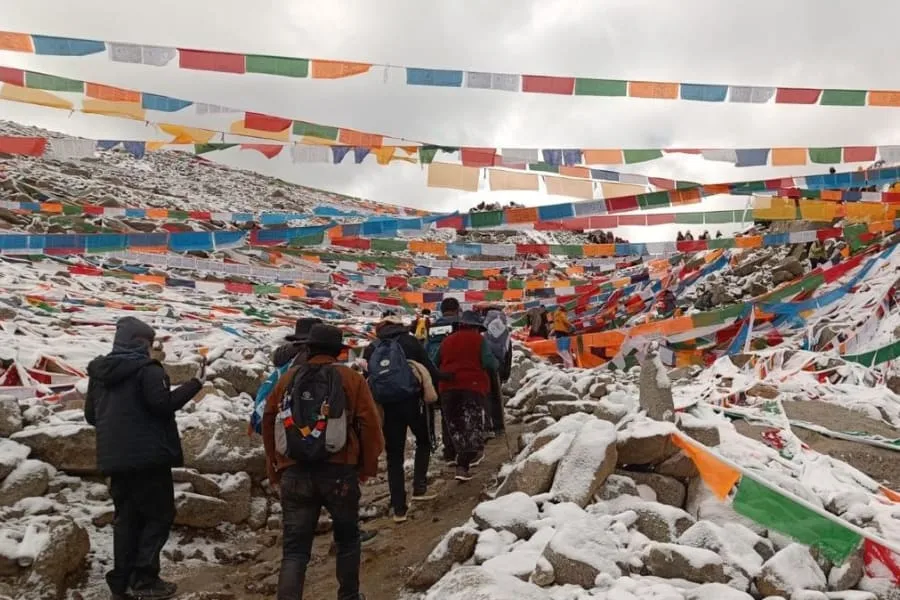
This is the hard day. Everyone knows it in advance and still underestimates it. The climb to Dolma La Pass (around 5,630 m) is long, steep in places, and the air is genuinely thin. We left before dawn. The trail is rocky, the wind picks up, and every step requires attention. Prayer flags and offerings mark the pass. People leave something behind — a piece of clothing, a small token, a quiet prayer. Crossing the pass felt like crossing a threshold. The descent on the other side is long and hard on the knees. You pass Gauri Kund, a small sacred lake, and continue down toward Zuthulphuk. By the time we reached the guesthouse my legs were finished and my head was pounding. That night I slept better than the night before, simply from exhaustion.
Day 3 – Zuthulphuk back to Darchen
The final stretch is gentler. The mountain is still there, but the intensity of the previous day has passed. You walk, you talk less, you notice the small things — the colour of the rock, the sound of the wind, the way the light moves across the slopes. Completing the circuit and walking back into Darchen felt quieter than I expected. No big celebration. Just a kind of settled tiredness and the knowledge that the circle was closed.
What stayed with me most was not a single dramatic moment but the steady presence of the mountain over those three days. It does not change for you. You change a little while walking around it. The physical difficulty is real — altitude is the main filter. People who are very fit at sea level can still struggle. People who prepare properly and respect the pace can manage. The facilities on the kora are basic: simple rooms, shared toilets, limited electricity, food that is functional rather than memorable. Bring layers, good walking shoes, a solid sleeping bag liner, and more patience than you think you need.
The return journey felt different. The same roads, the same high plateau, but the mountain was now behind us instead of ahead. In Kathmandu again, ordinary things — traffic noise, thick air, familiar food — felt strangely loud.
I would go again, knowing exactly how hard the second day is. Not because it was easy or comfortable, but because the combination of the landscape, the silence, and the slow walking around that particular mountain is unlike anything else I have done.