
In early 1973 Chris Perkins crossed the Mekong into Laos on a Thai visa run, without realising there was a war on. He lives there now. Here is what he remembers, and what the same journey looks like fifty years later.
The border with nobody on it
Four young Englishmen who had met on a bus came up through Chiang Mai to Chiang Rai and down to the river at Houayxay. A small boat took them across the Mekong. From the water they could see longhouses on top of the cliffs, which was how a great many people lived then.
They stepped off on the Lao side and walked up to the border post.
The barrier was up. There was nobody behind the desk: no guard, no official, nobody to look at a passport or ask a question, nobody to wave them through or turn them back. The hut stood empty, in a country that had, until days earlier, been the most heavily bombed place on earth.
They kept walking.
"It never occurred to me that there was a war on," Chris says. "I never thought about it."
He had come for the most boring reason imaginable. Thai visas lasted a month at a time, so once a month you left the country and came back in. He picked Laos because it was across the river.
He had arrived days after the Vientiane Agreement. Signed on 21 February 1973 and in force from noon the following day, it ended nine years of American bombing. By then Laos had been bombed more heavily per head of population than any country in history. Chris knew none of it.
It is the part of this that is hardest to imagine now. Today you would know. A news alert would have gone off in your pocket somewhere around Chiang Rai. Someone in the group chat would have sent a link. The hostel would have had it on in the background, and three people in the dorm would have told you what they had read about the border.
In February 1973 there was none of that. No phone, no internet, no way of checking anything. News reached you when you reached a city with a newspaper in a language you could read, or when another traveller who had come the other way told you what they had seen. You worked out where you were going from a noticeboard and whatever the last person said. Letters home took weeks, and the replies went to a poste restante counter you might reach a month later.
So it was entirely possible to spend a month in Thailand, decide on a whim to cross into the next country, and have no idea that it had been at war for nine years, or that the war had stopped the week before.
Then and now: he learned there had been a ceasefire because a gate was open and the guards had gone off to celebrate. Today you cross at the Fourth Thai-Lao Friendship Bridge with a visa on arrival, and you would have read about a ceasefire on your phone before the bus reached the river.
The two men in the cafe
Luang Prabang in 1973 was a small place. Fifty thousand people at most, the royal capital of a kingdom, sitting where the Nam Khan runs into the Mekong. Wooden Lao houses and whitewashed French villas, gold-roofed temples taking up a third of the town, monks out at dawn. Eighty years of French rule had left coffee and bread behind, and in February the mornings come in cool before the heat settles.
It was also, quietly, a staging post for a war nobody admitted was happening. The Americans had an air operations centre here. On the maps the pilots used it was Lima Site 54.
A young Lao man took the four of them under his wing, found them a bunk room that Chris believes was connected to the Americans, and took them out for coffee.
Two Westerners were sitting at another table. Short haircuts. Civilian clothes, because that was the uniform: men whose names had been taken off Defense Department rosters and who flew in whatever they liked, some of them in jeans and sunglasses and cowboy hats. Nothing to say who they worked for.
Chris had barely seen a foreign face in weeks. He got up to go and say hello, the way you do.
He was called straight back.
"He said, no, no, no, no. They're pilots. Air America. They have no interest in talking to you."
Air America was the airline the CIA owned and ran. Through the 1960s and early 70s it flew supplies, surveillance and personnel across Laos in a war the United States officially denied was happening. It kept flying until June 1974.
Then and now: Luang Prabang is a UNESCO World Heritage site and its cafes are full of foreigners. In 1973 two foreigners in a cafe were worth crossing a room for, and might have been running a secret war.
Ten boats of journalists and no ticket desk
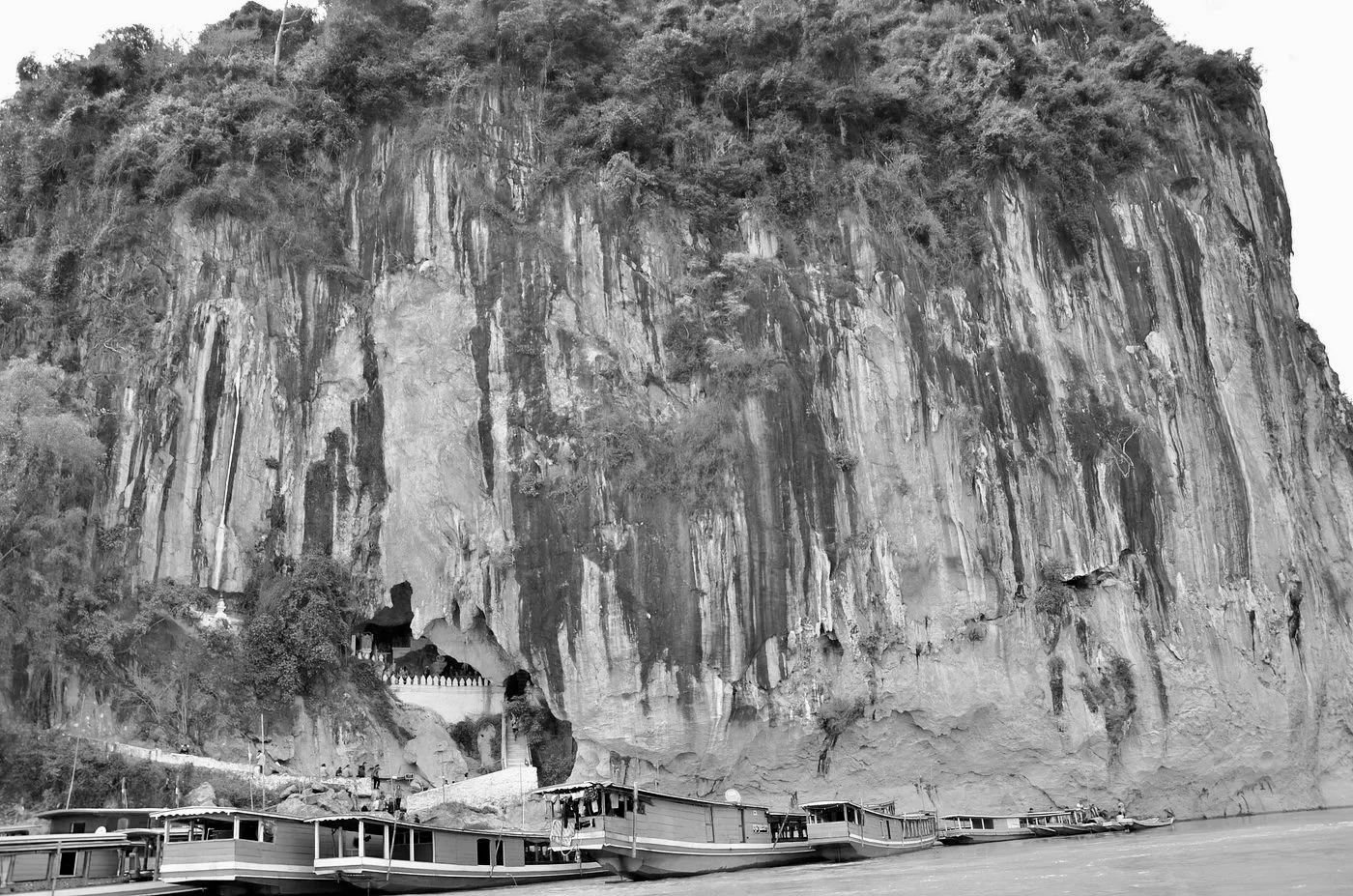
The ceasefire had brought the world's press to Luang Prabang, and somebody organised a trip upstream to the caves at Pak Ou, two chambers in a limestone cliff where the Nam Ou meets the Mekong, filled with thousands of Buddha images left there over centuries.
Chris counted ten or twelve boats going up the river. Nearly all of them journalists, cameras and notebooks, with a handful of travellers tagged on the end. For a few days in February 1973, a quiet bend of the Mekong had more foreign correspondents on it than it would see again for twenty years.
There was no fee and no ticket desk. You turned up and looked. Afterwards, somebody bought ice cream.
Asked what the inside was like, he says it was exactly what you see today. Rows and rows of them.
Then and now: Pak Ou is on every Luang Prabang itinerary, a two hour boat trip with an entrance fee. The cave is unchanged after fifty years. Everything around it is not.
Ten dollars and the plane without the bullet holes
When they talked about taking a boat back down the Mekong, their host stopped them.
"He said, no, the war is not over. They'll use you for target practice."
So they went out to the airfield instead, and this is the image Chris has carried for fifty years. No terminal, no tower, no buildings of any kind that he can recall. Only a strip, and two DC-3s standing on it in the heat.
One of them had a front windscreen full of bullet holes.
They took the other one.
The ticket cost $10. A man pointed at the aircraft. That was the entire process: no check-in, no seat number, no safety card, nobody asking for a name. The domestic carrier then was Royal Air Lao, flying DC-3s, the wartime workhorse that had been landing on rough strips since the 1940s and was, by 1973, around thirty years old.
A DC-3 sits nose-up on two fat wheels and a small tail wheel, so the floor slopes and you climb uphill between the seats to reach your own. Then the engines start, and everything that is bolted together starts working against everything else. Chris sat and watched the wings flex up and down and the loose rivets vibrating in their holes, with nothing below but jungle in every direction and nowhere to put an aeroplane down.
"Oh, shit, this is a long way."
Then and now: he flew because the river was dangerous, on a 30 year old aeroplane with no schedule to speak of. Since December 2021 the Laos-China Railway covers Vientiane to Luang Prabang in a little over two hours at 160km/h, on a line that runs almost two thirds of its length through tunnels. Before it opened, the road took eight or nine hours.
The soldiers
One image complicates all of this.
Somewhere in those few days Chris took a photograph of soldiers who looked about ten years old, holding guns that were longer than they were tall. He does not remember where, or what he thought at the time. He took the picture and moved on.
Beyond that he saw nothing. No ruins, no craters, no checkpoints.
There is a reason for that, and it is not that the bombing was exaggerated. The war had a geography. The heaviest of it fell on Xieng Khouang in the north-east, where the Plain of Jars was fought over and bombed flat, and on the southern panhandle where the Ho Chi Minh Trail ran down the Vietnamese border. Chris was in neither place. He crossed in the far north-west, went down the Mekong corridor to Luang Prabang, and flew to Vientiane. He travelled through the parts of the country that were being fought over least.
He may have come closer than he realised. The DC-3 put down somewhere on the way south to pick up or drop off, and the passengers were kept on board. Chris thinks it might have been Long Tieng or Phonsavan. Long Tieng was the CIA's base for the entire secret war, a town of tens of thousands that appeared on no map. Phonsavan sits on the Plain of Jars. He does not know which it was, and he never got off to look.
That is the thing about a war that is officially not happening. It was not hidden from him by accident. It was built to be invisible, right down to the civilian clothes on the men in the cafe, and for most of a week it worked perfectly on a 26 year old with a rucksack.
Then and now: the damage was real, it just was not where he was. Millions of unexploded cluster bomblets are still in the ground across Laos and they still kill and injure people every year. In Luang Prabang today you can walk into the UXO Lao visitor centre and see what had been falling on the country in the years before he arrived.
How you travelled
There were no bookings because there was nothing to book with. You turned up. There were no guidebooks worth the name, since Lonely Planet's first title appeared that same year and the route ran on noticeboards and whatever the last traveller told you. Letters home were aerogrammes, a single sheet of tissue-thin paper written on both sides, folded into three and posted.
Chris had £300 to last 15 months, because British exchange controls capped what you could take out of the country, so he worked as he went. He had come overland from North London through Afghanistan, still a monarchy that year, then Goa, Calcutta and Burma.
Then and now: he crossed into a war zone without knowing, because there was no way of knowing. Your phone would have told you before you got off the bus.
He went back
Chris returned in 2006, aged about 59, to see a friend running a guesthouse in Vang Vieng. He met his wife there, stayed seven years, and now lives in a village outside Paksan.
He measures the change in traffic and in height. In 1973 there was one building in Vientiane over three storeys, a tourist hotel on the riverbank, and it stayed the tallest thing in the city for decades. Vang Vieng had no paved roads when he arrived in 2006, and when they sealed them a few years later they sprayed tar straight onto the mud.
The country he walked into through an open gate closed almost entirely to Western visitors after 1975. The king he was shown at the ceasefire ceremony, Savang Vatthana, was arrested in 1977 and died in a camp in Houaphan.
Every photograph from that trip is gone, lost when his brother's basement flooded. The two aeroplanes, the figures in the cave, the children with the guns. All of it in a cardboard box, under water, decades later and half a world away.
What is left is a gate with nobody under it, two men with short haircuts who did not want to be spoken to, and a $10 ticket to fly over the jungle in an aeroplane with loose rivets.
That, and a 200 kip note he still has, with the king's face on it.