
By Natalia Fediachkina
"The mountains are calling and I must go" ... John Muir
It is a strange thing to return from the end of the earth and find that your heart has stayed behind. The Pamir Highway did that to me - this fabled M41 that winds through the "Roof of the World", one of the highest international roads on the planet. For nine unforgettable days, I journeyed from the ancient Silk Road city of Samarkand in Uzbekistan, across the border at Jartepa into Tajikistan, through the green boulevards of Dushanbe, across the stark, beautiful moonscapes of the Tajik Pamirs, over the border into Kyrgyzstan, descended at last into the ancient city of Osh. I am from Kyrgyzstan, a neighbor to Tajikistan and yet this world of soaring peaks and boundless hospitality felt like an entirely different planet.
This is the story of a journey that taught me that the greatest obstacles exist only in the mind, and that the kindness of strangers can turn a lost traveler into a cherished guest.
How I Booked
I did not book a package. The Pamir Highway demands flexibility, and the experience is far richer when pieced together independently. I arranged my trip through a combination of word-of-mouth and local contacts. My dear friend Sharaf, a local guide, was invaluable. He connected me with families and historians for my podcast project and helped organize a private 4WD with a driver. It is the most common and recommended way to travel this route. The road conditions are too challenging to self-drive unless you are a very experienced off-road driver. The route is long, navigation is difficult, the road surfaces range from decent tarmac to nothing at all.
What I paid:
I opted for an all-inclusive package: a private, last-model 4WD with a personal driver, all food, accommodation, and logistics for the entire 9-day journey. The total cost was $1,800. This might seem steep at first glance, but for the peace of mind and the sheer luxury of having a clean, reliable vehicle and a driver who became a friend, it was worth every penny.
Other costs:
Homestay accommodation with breakfast and dinner: $25 per night (without lunch)
GBAO permit: $25
Visa: Not required for Kyrgyzstan citizens
Would I book the same way again? Absolutely. I am forever grateful to Sharaf, who even washed the car himself so that I would sit in a clean vehicle with crystal-clear windows to enjoy the views. He said it was a matter of honor and for him, it was.
Getting There
My journey began not in Dushanbe, but in the fabled city of Samarkand, Uzbekistan, the jewel of the Silk Road. The drive from Samarkand to the Tajik border at Jartepa is a short one, taking approximately 2-3 hours. Crossing the border was straightforward, though it required patience as with any land crossing in Central Asia. From there, it was another 3-4 hours to Dushanbe. It is a route that connects civilizations, from the turquoise domes of Registan to the green parks of Tajikistan's capital.
The drive to the border of the Gorno-Badakhshan Autonomous Region (GBAO) is where the adventure truly starts.
Dushanbe to Kalaikhum: The first day was a long one, covering roughly 370 kilometers in about 7-8 hours. The road is mostly paved, winding through the mountains and past the stunning Nurek Reservoir. Even shrouded in clouds, I could not tear myself away from its beauty. The highest point on this stretch is the Shuroabad Pass (1,959 meters).
Kalaikhum to Khorog: This is where the highway becomes legendary. The road hugs the Panj River, which forms the border with Afghanistan. Afghan villages were just a stone's throw away across the water. The road here is rough—a combination of dirt and old, broken pavement. It is a slow, 240-kilometer, 8-hour journey through a narrow gorge, and the dust is so thick you have to keep the car windows shut.
The journey from Dushanbe to Khorog is typically split over two days, with an overnight stop in Kalaikhum.
Where I Stayed
Accommodation along the Pamir Highway is a world away from luxury hotels, and that is exactly the point. The heart of the experience is the homestay. These are family-run guesthouses offering basic but spotless rooms and incredible home-cooked meals.
Kalaikhum: I stayed at Sobir Guesthouse, a charming riverside place with a beautiful terrace. The hospitality was overwhelming; the whole family took part in serving dinner.
Khorog: The regional capital offers a few more modern options. I stayed at the Pamir Lodge, a comfortable and social hub for travelers. But the most memorable meal here was not in a restaurant, it was in a local family's home, where I was served a steaming bowl of soup made from yak (local meat) with crusts of grey bread. It was the most delicious, soul-warming home-cooked meal of the entire journey, simple yet unforgettable.
The Pamiri Home: One night, we stayed in a traditional Pamir house. It is here, under thick blankets and after a hearty meal, that you truly feel the spirit of the mountains. The rooms are simple, often with shared bathrooms, but the warmth of the families is unmatched.
Bulunkul and Murghab: In the high-altitude desert of the east, the landscape is stark and beautiful. I stayed in guesthouses in Bulunkul and Murghab, where I met other travelers and shared stories over tea in the cold evenings. It was here I witnessed a Kyrgyz nomadic family packing up their entire home to travel to relatives, piling five people and all their belongings into one car. It was a beautiful example of the resilience and community that defines this place.
Karakul: On the shores of the breathtaking Karakul Lake, I stayed with a local Kyrgyz family. In the morning, I watched as the driver of a local taxi - shared car heading to Osh, carefully helped the family load their belongings. Five people squeezed into the back seat, surrounded by bags and bundles, set off across the vast plateau. It was a scene of pure, unscripted Central Asian life.
What I Did
The Pamirs are not a destination where you tick boxes; they are a place to be experienced. Every day presented a new marvel.
Dushanbe: Two Days of Discovery
Before the journey, I spent two days exploring the capital. Dushanbe is a city of green parks, wide boulevards, and Soviet-era charm mixed with modern development. A highlight was the National Museum of Tajikistan, which houses an extraordinary 13-meter reclining Buddha statue found in Kulyab. It is a powerful testament to the Silk Road's Buddhist heritage. I also wandered through the bustling Mehrgon Market, where the colors of fresh fruits, spices, and dried nuts were a feast for the senses. The city felt safe, relaxed, and welcoming—a perfect prelude to the wild landscapes ahead.
The Road to Kalaikhum: Hulbuk Fortress and Nurek Reservoir
On the way to Kalaikhum, we stopped at the Hulbuk Fortress, a citadel dating back to the 9th-10th centuries. The museum nearby, full of ancient artifacts, was a deep dive into the region's history. I was fortunate to meet a local historian, Mr. Abdullo Khodjaev, who shared stories of the fortress's past, speaking with such passion that the ruins seemed to come alive. We listened to tales of ancient rulers, Silk Road caravans, and the ebb and flow of empires. It was a moment that reminded me why I travel, not just to see, but to understand.
Later, as we passed the Nurek Reservoir, the largest in Tajikistan, I insisted on stopping. Even with clouds hanging low over the water, the view was mesmerizing. I stood there for a long time, unwilling to leave, absorbing the stillness and grandeur.
The Wakhan Corridor: Journey Through History
This was the absolute heart of the journey. As we drove from Khorog to Ishkashim and into the Wakhan Valley, the scenery became otherworldly. On the one side were Tajik mountains; on the other, across the Panj, the Hindu Kush of Afghanistan. The views of the Pamir and the Afghan mountains were breathtaking. This is the legendary corridor created as a buffer between the Russian and British empires during the Great Game.
Along the way, I saw Afghan men on the opposite bank of the river, panning for gold and casting fishing nets into the swift currents. Their mud-brick houses clung to the mountain slopes, surrounded by small green gardens - a fragile beauty in a harsh landscape. It was a powerful reminder of how close yet how far two worlds can be.
Yamchun Fortress & Bibi Fatima Springs
A 12th-century fortress perched on a cliff, offering a panoramic view of the valley, is a must-visit. I climbed the ancient stones, feeling the wind whip through my hair, and imagined the soldiers who once stood guard here. A short walk from the fortress are the Bibi Fatima hot springs, where warm, mineral-rich water flows from the rock. Here, I had my most cherished moment. A colonel of the border guards, whom I had been hoping to meet for a photo, approached me and offered to take a picture together. My joy was childlike; it felt like the universe had heard me.
Khargush Pass and the High Lakes
Leaving the lush Wakhan, the road climbs over the Khargush Pass (4,344 meters) and enters the stark, lunar landscape of the eastern Pamirs. Here, the terrain is a high-altitude desert inhabited by Kyrgyz nomads. The drive to the Bulunkul and Yashilkul lakes was a voyage into a dream. The lakes, mirroring the mountains, are some of the coldest inhabited places in Central Asia.
At Bulunkul, I visited the first school for children in this remote region. I interviewed the director, a woman with a quiet dignity, who spoke of the challenges of educating children in such an isolated place. Her dedication moved me deeply, and I made a donation to support the school and its students. Later, I was treated to the most delicious freshly caught fish at the local guesthouse, cooked simply but perfectly.
Yashilkul Lake was another highlight. The director of the local nature reserve helped me secure the necessary permits to visit, and I spent hours there, my drone buzzing overhead, capturing every shade of blue and green. I also visited a rehabilitation center for snow leopards, where I met the director and even had the chance to feed these magnificent creatures. Standing so close to a snow leopard, looking into its wild eyes, was humbling and exhilarating.
Murghab & the Ak-Baital Pass
Murghab, the highest town in Tajikistan at 3,600 meters, felt like a windswept frontier town. From here, we tackled the Ak-Baital Pass, the highest point of the journey at 4,655 meters. It was so cold the wind was freezing, but the sun somehow warmed my heart as I launched my drone to capture the snow-capped peaks. The views were so spectacular that I didn't want to close the car window, but the dust forced me to.
Karakul Lake
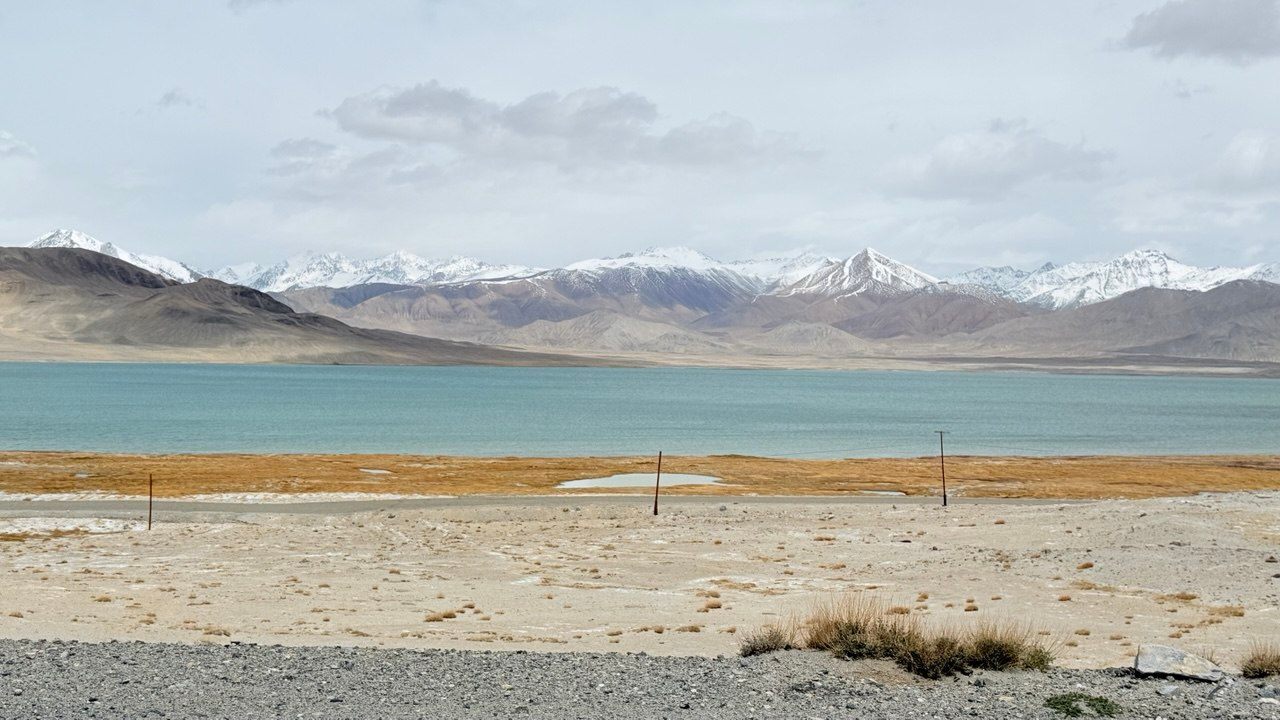
We visited Karakul Lake, the largest lake in Tajikistan, a vast body of water in a desert landscape, formed by a meteorite impact millions of years ago. It was here that I "hunted" for a photo of a camel herd and ran 10 kilometers across the plateau to photograph a family of marmots at nearly 4,000 meters. The sheer emptiness and silence of the landscape were overwhelming.
Note on Hiking
There were many moments of spontaneous exploration. I visited the Garmchashma hot springs, walked to the sources of Bibi Fatima, and even walked to the Buddhist stupa near Langar. This region is perfect for day hikes, and every turn in the road revealed a new wonder.
People Along the Way: Stories That Stayed With Me
The Pamir Highway is not just about landscapes; it is about the people who call this harsh, beautiful place home. Every person I met had a story, and I was privileged to listen.
The Driver Who Became a Friend
Sharaf was more than a driver; he was a guide, a friend and guardian. When I got lost in Khorog - yes, I managed to lose my way in "three pines" - he searched the city for me until he found me. He insisted on washing the car himself so I would ride in comfort. He played Tajik music on the stereo and we sang along, laughing until our voices grew hoarse. He was a man of quiet dignity and boundless generosity.
The Botanical Garden Adventure
In Khorog, I decided to visit the famous botanical garden. On the way, I got hopelessly lost. A local bus driver noticed my confusion and, treating me like an honored guest, personally drove me to the garden. There, I met a scientific researcher who had just undergone eye surgery. Despite his recovery, he agreed to give me a private tour because, he said, he simply loved walking through the garden. His passion for the plants was infectious, and his kindness in the midst of his own discomfort moved me to tears.
The Mayor of Khorog
When I was lost, my search for my guesthouse somehow led me to an unexpected meeting with the mayor of Khorog himself. He listened to my story, called to ensure I was safe and made sure I found my way back. It was a surreal moment, a reminder that in the Pamirs, even the highest officials are accessible and genuinely care for travelers.
The Woman from Samara
In Kalaikhum, I interviewed a woman who worked at the guesthouse. She was originally from Samara, Russia, but had fallen in love with a local Pamiri man and moved to this remote village of Zing to build a life with him. I asked her about the challenges, and she smiled, saying she had never been happier. Her story was one of courage and love, I felt immense pride in her decision to embrace such a different life.
The Loving Couple
At another guesthouse in Zing village, Mr. Okilsho & his spouse, the hostess was shy and hesitant to speak on camera. But when her husband of 35 years arrived, she blossomed, chirping happily beside him like a little bird. Watching their mutual love, the way they finished each other's sentences and laughed at private jokes, was a lesson in enduring partnership. I couldn't stop watching them.
The Ismaili Faith & the Spirit of Joy
The Pamiris I met follow the Ismaili branch of Islam, and they taught me something profound: to radiate joy, to overcome difficulties with pride, and to believe in my own strength. They reminded me that you always have family and neighbors who will help you. Their philosophy of resilience and community changed the way I see the world.
A Marriage Proposal
On a roadside bazaar, I became a witness to something beautiful - a man proposing to the woman he loved. The moment was so private yet so public, I felt privileged to be there, capturing the joy and nervousness in their eyes. It was a reminder that love finds its way even to the most remote corners of the earth.
Where I Ate and Drank
The food on the Pamir Highway is simple, hearty, utterly delicious. Most meals are taken at your homestay, which is often the best option.
Dushanbe: In a cafe in the capital, I ordered kurutob - traditional dish of yogurt, bread, vegetables. The portion was massive, I couldn't finish it. But for days afterward, I savored the memory of its tangy, comforting flavor.
Khorog: As I mentioned, the most unforgettable meal was in a local family's home. They served a soup made from yak, local meat, accompanied by crusts of grey bread. It was the simplest dish, but it was the most delicious thing I ate on the entire journey - taste of Pamiri hospitality at its purest.
Roadside Cafes: We stopped at simple roadside cafes frequented by truck drivers. As the only woman in the room, I was initially the center of attention. But with a smile and a few words in Russian or Kyrgyz, I was welcomed. Soon, we were all laughing together, sharing stories and making jokes. In one such place, I was offered a cup of tea that tasted of the mountains themselves.
The Unusual: In one remote village, I went looking for breakfast at 10 am, only to find the shop was selling two-liter plastic bottles of vodka. In the far east, it is a common sight - a reminder that you are in a place where practicality trumps convention.
Coffee in a Teapot: On cold evenings in Bulunkul, Karakul, and Murghab, I would brew coffee in a teapot, as instant coffee was the only option. It became small ritual, taste of home in the freezing nights.
The Verdict
Would I go back? In a heartbeat. The Pamir Highway is not just a road trip; it is a pilgrimage. It is a journey to the roof of the world that will leave you feeling that the world is far bigger and far more beautiful than you ever imagined.
I recommend it to: The intrepid traveler, the photographer, the history buff, anyone who seeks genuine human connection over luxury.
Who should skip it? If you require constant Western comforts, reliable Wi-Fi, smooth roads, this is not for you. The journey is long, the roads are rough, the altitude is real.
Things I would do differently:
More Time: Seven days is the minimum, but I would recommend 10 days to two weeks to truly explore the Wakhan Valley and the Fann Mountains. With 10 days, you can add a side trip to the stunning Seven Lakes or the Iskanderkul Lake, a turquoise gem said to be where Alexander the Great's horse drank. The tunnel and pass leading to Iskanderkul - the Shahristan Pass - is terrifying but unforgettable.
Prepare for Altitude: Acclimatize in Dushanbe and Khorog before jumping to 4,000 meters. Altitude sickness is real and can ruin your trip.
Pack Wisely: Bring warm clothes for the cold evenings, a sleeping bag, and a good camera.
My Most Powerful Lesson: The people of the Pamirs- the Ismaili Pamirs - taught me a profound lesson. They taught me to radiate joy, to overcome difficulties with pride, and to believe in my own strength. They taught me that when you get lost in Khorog, you will not be left alone. A driver will take you to the botanical garden, a scientist just out of eye surgery will give you a private tour because he loves his garden, and a stranger will search the city for you, just to make sure you are safe. Their boundless hospitality was the greatest gift of all.
For the Traveler Dreaming of the Roof of the World
Know this: it is not a destination to be conquered, but a place to be felt. It will change the way you see the world, and more importantly, the way you see yourself. The Pamirs taught me that there are no obstacles- they are all in our heads. The mountains, the people, the sheer immensity of it all - it stays with you forever.
Tips for First-Timers
Get a GBAO Permit: You cannot enter the Pamirs without it. Get it as part of your visa application.
Hire a Driver: Unless you are a seasoned off-roader, hire a local driver. They know the roads, the best stops, the best homestays.
Book a Homestay: This is not only the most affordable option but the most authentic.
Pack Warm: Even in summer, nights are cold. A down jacket is a must.
Bring Cash: There are no ATMs in the remote mountains. Get your money in Dushanbe or Khorog.
Be Flexible: Road conditions change, border crossings can take time, and weather is unpredictable. Go with the flow.
Crossing from Uzbekistan: If you are coming from Samarkand, Jartepa border is straightforward. Allow extra time for the crossing.
Find a Local Friend: Having someone like Sharaf made all the difference. He opened doors, found historians, made sure my journey was safe and meaningful.
Embrace the Unexpected: Getting lost, meeting strangers, eating in roadside cafes - these are the moments that make the journey unforgettable. Let go of control and let the Pamirs guide you.
A Final Word of Gratitude
Dear reader, thank you for journeying with me through these pages. If you have reached the end of this story, I am deeply grateful. The Pamir Highway is not a place you simply visit, it is a place that visits you, leaving an indelible mark on your soul. I hope my words have inspired you to dream, to plan, and ultimately, to go.
To see more photos from my journey, for questions, advice or just to share your own travel dreams, feel free to reach out, follow me on Instagram: @novatravel.world
I would be honored to help you plan your own unforgettable adventure across the Roof of the World. The mountains are calling - will you answer?
With gratitude & wanderlust,
Natalia